Hasta reads a photo of your palm through three traditions: Samudrika Shastra, Western chiromancy and the Chinese five-element school. You get a free reading, a card that names your hand, and a full manuscript for ₹99.
Role
Lead Designer, UI/UX/AIX, at Produsa Labs
Timeline
1 month, launched August 2026
Platform
Web product, hasta.produsa.app
My work
Product research, the canon, UI/UX, and the AI experience: reading output, chat behaviour and prompts. I led the features, the hand card, pricing and the ethics rails. Built with a small engineering team.
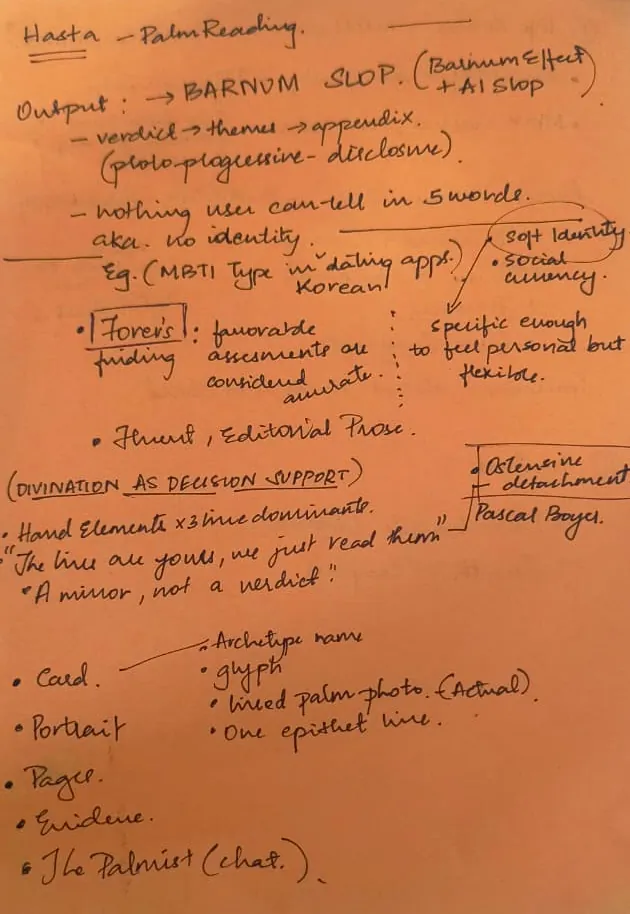
I started at the output. The first page of my notebook asks what the reading itself has to be before any screen around it is worth designing.
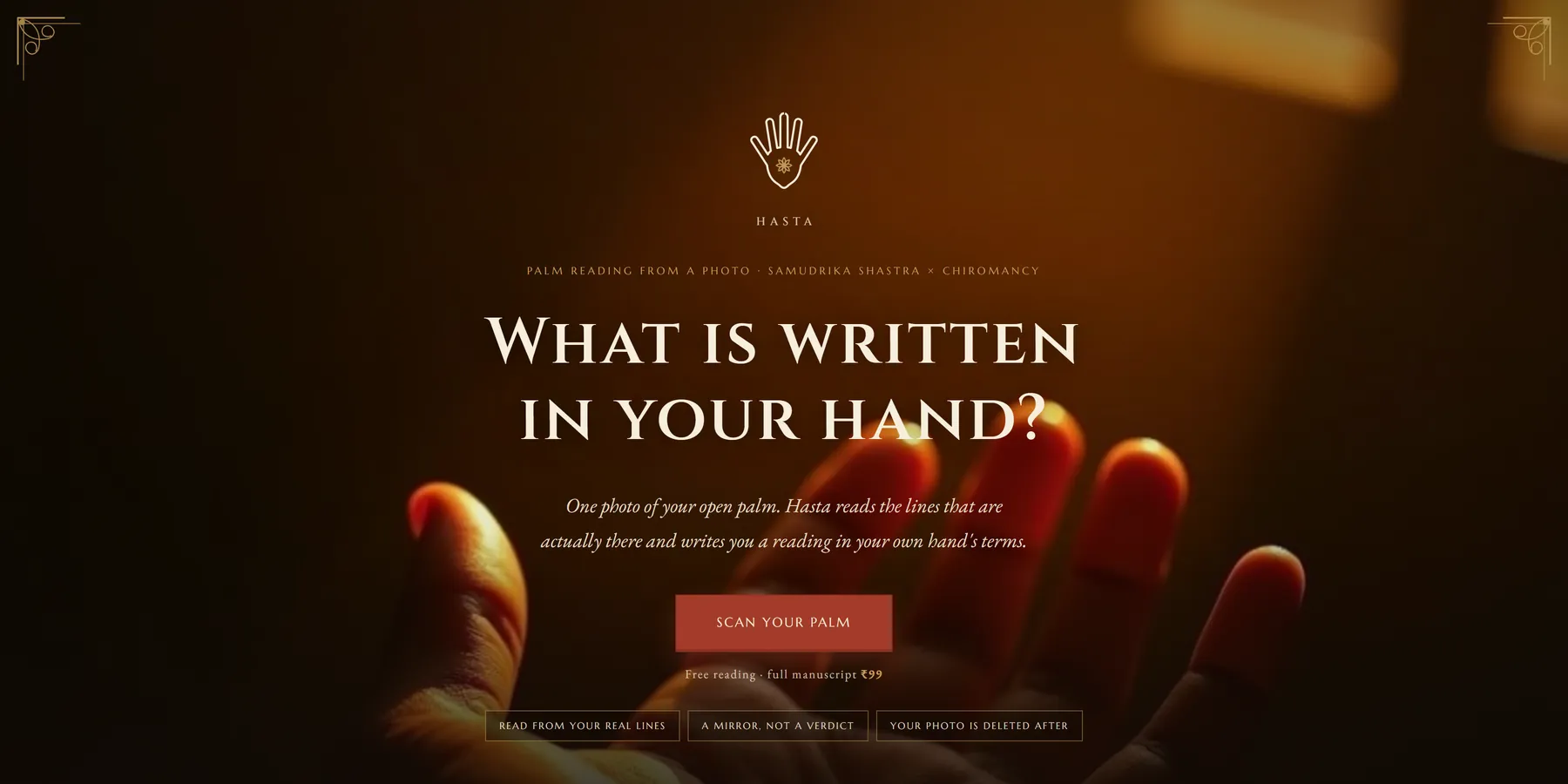
The landing page. One photo, one price, both on screen before anything is asked.
The problem
Open any palm app and the reading fits anybody.
Bertram Forer showed why in 1948: he handed his students a personality profile he had assembled out of a newspaper astrology column, and they rated it as an accurate description of themselves. Statements that are favourable and flexible read as personal, which is the Barnum effect.
Language models made that cheap. They write fluent prose that sounds like a reading and is tied to nothing on the hand in the photo. My notebook calls the two of them together Barnum slop, and it is the whole category.
The second failure is quieter.
After one of those readings there is nothing you can tell a friend in five words. No identity, just a paragraph you read once. People put INFJ in their dating profile because a label about yourself is social currency, and palm reading, which is about you more directly than any personality test, was handing out nothing to carry.
Every claim had to point at a mark that is actually on the hand in the photo. And the reading had to end with something worth repeating to a friend.
What I found
Readings repeat themselves because they read too few features. Hand shape and the three big lines, which nearly every hand on earth offers, give a model almost nothing to work with, so it fills the rest with lines that fit anyone.
Generic doesn't feel wrong to the person reading it. That is Forer's finding, and it means user complaints would never surface the problem. It had to be measured instead.
Two things people reliably share are a label and a picture. A reading is neither.
Some of the most familiar palmistry is unusable. Earth, Air, Fire and Water hand types date from 1965 and can't be sold as tradition, and DMIT and finger-ratio claims are pseudoscience. All of it stayed out of the canon.
1 / 2
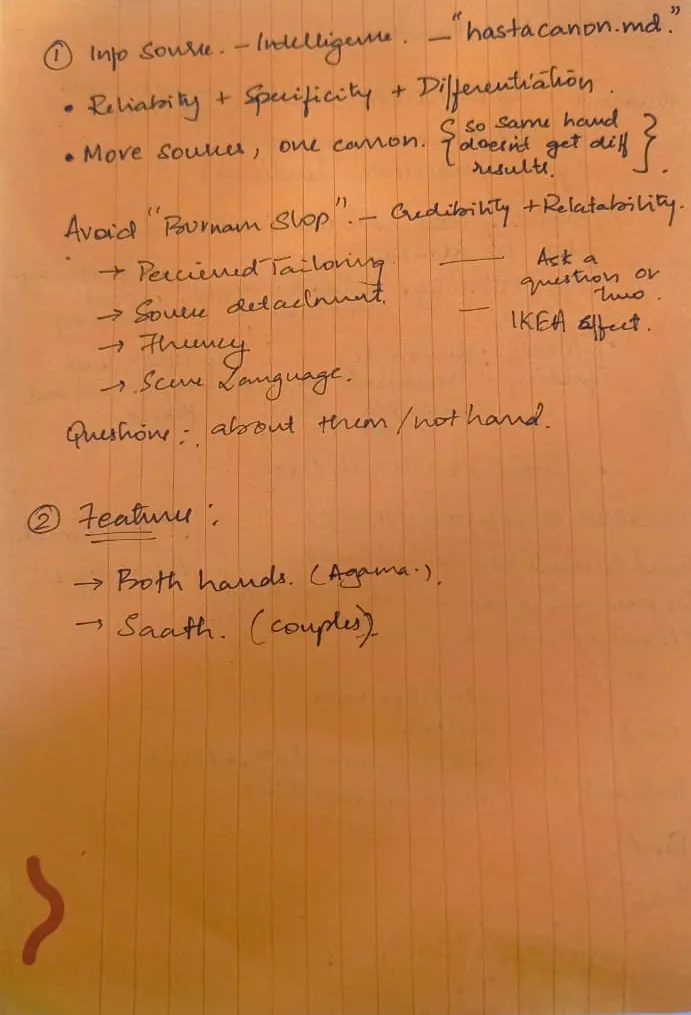
The two pages the product was argued out on. Everything below is on one of them.
Key decisions
01
More sources, one canon
I directed a study of six palmistry traditions and supplied the source material: deep research, transcripts of classical books and lectures, and recordings of practising pandits.
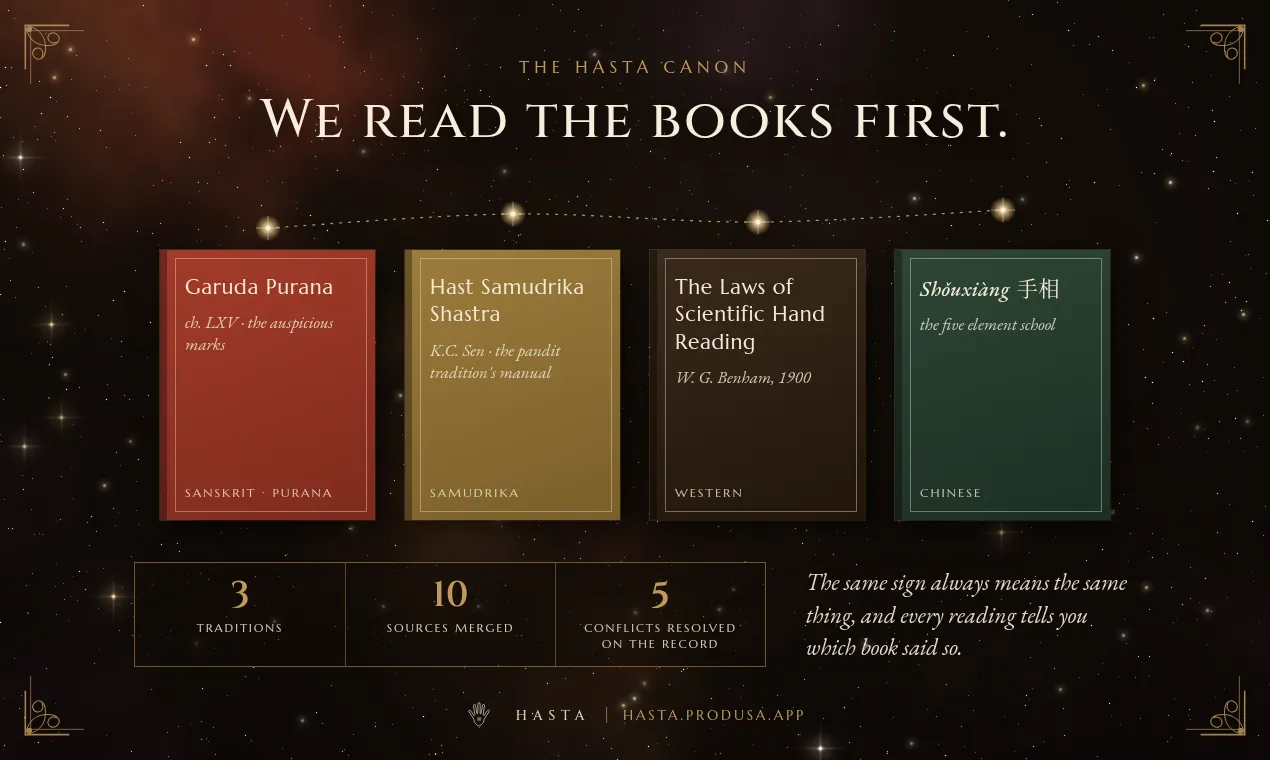
Three traditions made it into the product, and ten sources were merged into one rulebook: the Garuda Purana, K.C. Sen's Hast Samudrika Shastra, W.G. Benham's The Laws of Scientific Hand Reading from 1900, and the Chinese five-element school.
A sign earned its place on three counts, and I wrote them at the top of the page: reliability, specificity and differentiation.
It had to come from a source I could name, say something precise, and tell one hand apart from another.
They merge into one canon rather than sitting side by side, because the same hand must not get a different reading depending on which book the model happened to reach for.
The rulebook loads as cached ground truth and the model may only read in its vocabulary of lines, mounts and classical signs. That fixed vocabulary is what makes citing a source possible at all.
Trade-off: The reading cannot say anything the canon doesn't carry. That is the point, and it also caps how surprising a reading is allowed to be.
The canon, shown on the site as the books it came from.02
Measured the genericness instead of trusting my ear
The prompt bans the cold-reading phrases by name, and one layer of it says only: read this hand.
Then a weekly eval harness runs an independent model across readings and scores each one for faithfulness, distinctiveness and genericness, tracked release over release.
Underneath that sit the four levers I had sketched for why one reading feels tailored and another doesn't.
Perceived tailoring: the sentence points at a mark that is on your hand.
Source detachment: the claim belongs to a book, not to us.
Fluency: editorial prose rather than horoscope rhythm.
Secure language: it commits, instead of hedging its way to safety.
Trade-off: Every release costs extra eval runs. Genericness is the category's defining failure, so it's the thing I was willing to pay to watch.
03
Stopped the reading at 72% to ask one question
At about 72% the reading stops and asks one thing.
When a group settles on a plan, would you still rather go your own way? The answers are "That is me" and "I like to fit in", and the skip is written so it costs nothing: leave this one to our eye.
Two reasons. The answer gives the reading a self-report to weigh against a sign it only saw faintly. And a person who has put one hand on the thing values what comes out of it more than a person who waited for it, which is the IKEA effect doing work a loading spinner cannot.
The question is about the person, by design.
Asking whether their heart line forks would hand the reader our job and break the promise in the same sentence.
04
The hand holds the authority, and the product says so out loud
"The lines are yours, we just read them."
Hasta never speaks as a seer. A divination reads as true when the answer seems to come from the object rather than the reader, which Pascal Boyer calls ostensive detachment.
That one idea settles arguments further down. The reading is decision support, so it describes tendencies and never dates. There is no score, no forecast, nothing about marriage or children, and no gemstone to buy at the end. A mirror, not a verdict.
05
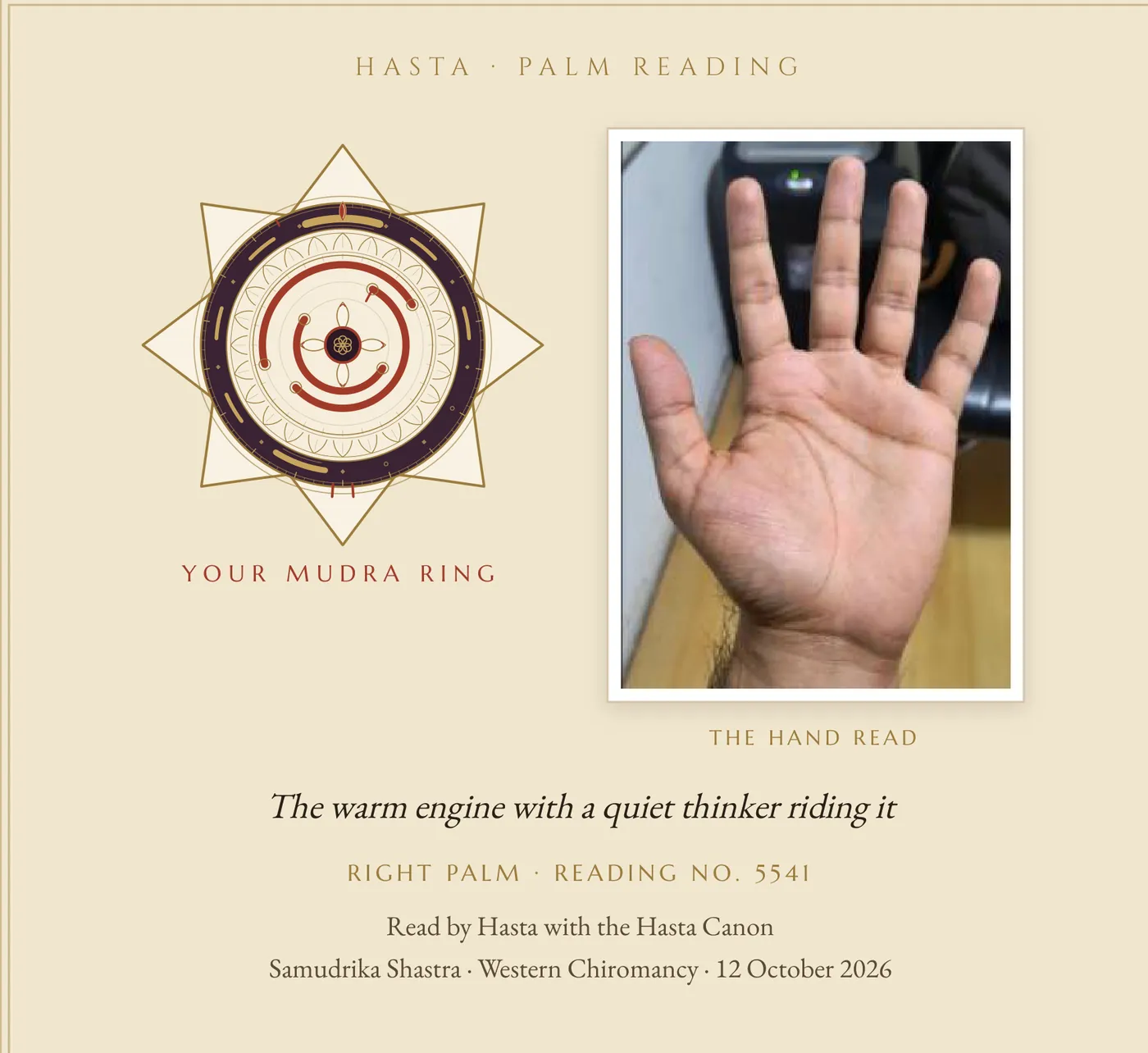
A card that names your hand
Every reading produces a card: an archetype name, a drawn glyph, the person's own lined palm photo, and a single epithet line.
The card is free and it arrives before the paywall, so nobody leaves empty-handed and every share is an advertisement that isn't selling fear.
It is the identity layer the category never had, and the label comes off the person's own hand. The privacy promise rides on the card too, which means every share repeats it to somebody new.
Trade-off: A card compresses a whole reading into a few lines and risks flattening it into a horoscope label. Carrying only the dominant readings, from the real photo, is what keeps it specific.
The card from a real reading. The glyph, the hand that was read, and one line to repeat.06
Verdict first, evidence last
The reading is ordered the way the notebook has it: verdict, then themes, then appendix.
The card, the portrait, the pages, the evidence, and then the chat for whatever is still unanswered. The person meets the conclusion before the apparatus.
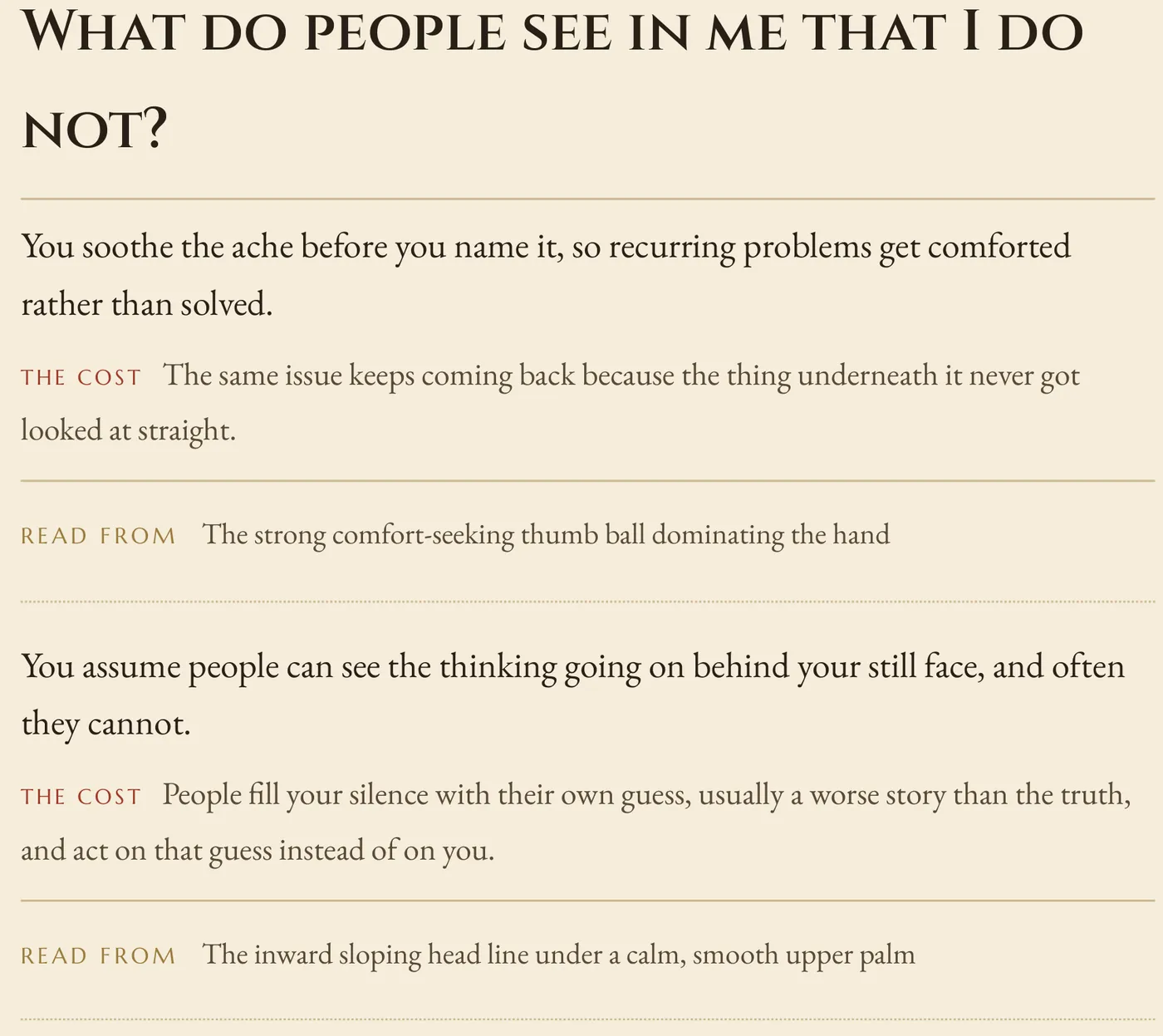
The evidence is there for anyone who opens it. Each claim names the line or mount it was read from and the book that says so, and the output schema makes the model declare for every line whether it saw it clearly, faintly or not at all, so it cannot describe a line that wasn't there.
Where the three schools disagree, the reading says which school says what.
Nine conflicts are on the register so far: five carry a ruling, three a recorded lean, and the serpent mark is still open.
Trade-off: Showing the working makes a reading less magical. Being checkable mattered more.
Every claim carries the feature it was read from, so the reader can check it against their own hand.
Two months in
850 readings in the first two months.
4.7% of free readings convert to the ₹99 manuscript, with no subscription, no countdown, no expiring credits and no fear-selling.
Built in one month, launched August 2026, live at hasta.produsa.app.
The price sits on the landing page before anything is asked of anyone. ₹99, once, for that reading.
One number I don't have: how many readings begin from a shared card. The identity layer is the reach bet of the whole product and it is still unmeasured.
Reflection
Instrument the share card on day one. The card is the reach bet of the whole product, and I still can't say how many readings start from one. That event should have been logged before launch, not left for later.
Measuring the output beat trusting my ear. Scoring the genericness caught readings that sounded fine and said nothing. On the next AI product I'd build a measurable check like that before the writing starts to feel right.