Rishabh Kumar
Work Desserts Contact
Home

Produsa

Turning a website build into a conversation

Produsa is a product from Produsa Labs. It researches, designs and builds websites for small businesses through a chat, on the web or on WhatsApp.

Role
Product Designer & Builder
Team
4: two designers, a developer and a project head
Timeline
February to October 2026, launched August 2026
Platforms
Web studio and WhatsApp
My work
Product direction, UX and UI design, studio layout, the conversational experience, token pricing, and agent orchestration, including the self-correcting and standards loops

Owners can't judge a design themselves, so they take the chat's word for it. Everything the chat claimed had to be checked against the page before it said it.

Chat on the left, the site building in the centre.

The problem

A good website still costs too much for many small businesses in India, especially outside the big cities.

Owners have two options, and neither works for them.

AgenciesWebsite builders
Expensive, with weeks of back-and-forth Expect the owner to make every design decision
Use terms the owner doesn't know English-first and built around templates
The owner can't edit the site afterwards Fixed monthly plans, whether the owner edits or not

These are owners of small and mid-sized businesses: a bakery, a bearings distributor, a cafe, a steel trader. They run on WhatsApp, and many don't work in English. They can describe their business, but not a website, so they can't judge a design and end up taking the chat's word for it.

So two things had to hold at once. The site had to be worth paying for, and the owner had to get there without making a single design decision.

Research: the alpha test

We onboarded 55 to 60 test users from different trades and let them build on the platform for real.

I ran clarity sessions to watch how they worked, and we put a feedback board inside the product so anyone could log a bug or ask for something. Two problems came back more than the rest.

  1. The build meter sat at 92%. We had built it to hold attention and it did the opposite, so it now moves with the real build and names what it is doing when a step runs long.
  2. Owners were giving the preview link to their customers instead of publishing. Previews now lock after ten days, and payment starts ten days after a site goes live.
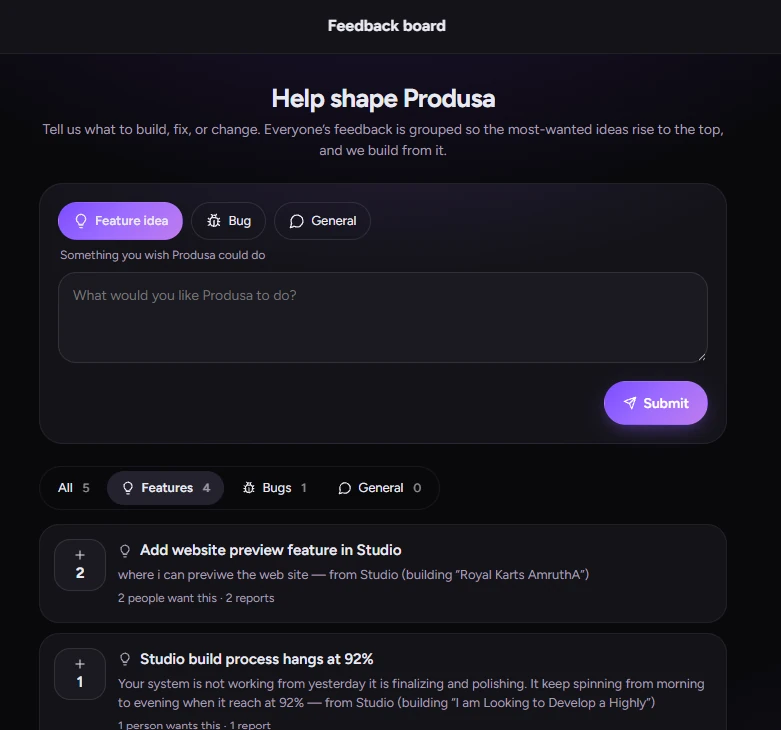
The feedback board inside Produsa: a form to post a feature idea, bug or general note, with the top posts below. One asks for a website preview in the studio; one reports the build hanging at 92 percent.
The feedback board. One post is the build hanging at 92%.

How it works

The build follows the order an agency works in. Each step is an agent: it does its part, checks the result against written standards, fixes what fails, then hands the build to the next.

One build, five agents, in order

  1. Owner's prompt
  2. 01Research
  3. 02Niche
  4. 03Brand design
  5. 04Prototype
  6. 05Website
  7. Live site

Inside every step

Checks its work against written standards
  • Passes, and hands off to the next step
  • Fails, so it fixes the work and checks again
Five agents, one after another. Each checks its own work before it hands off, so a weak step gets caught and fixed instead of shipped.

Key decisions

01

WhatsApp onboarding with no sign-up

The owner messages a number, answers a few questions about their business, and gets a designed prototype back in the chat.

Their phone number creates the account automatically, and they're asked for an email later. The first prototype comes out of the 15 free tokens.

Why: We considered a sign-up step before the first build and dropped it. Every extra step added friction between the owner and seeing their site appear, and that first prototype is what wins them over. Collecting details after the first build kept time to value as short as possible.
A few questions in a chat, then a prototype.
02

Questions about the business only

On the web, the owner types what they want to build.

The agent asks specific follow-up questions about the business, then asks for the logo and the feel they want. The build starts once it has enough to work with. The questions only cover what the owner alone can tell us, and the agents make every design decision.

03

A studio where the site builds in front of the owner

The chat sits on the left, and the site builds live in the centre and stays clickable throughout.

An active agent panel shows which agent is working (research, art direction, content, SEO or build), and a version history below the preview lists every earlier version of the site. Watching the site take shape is what builds the trust: owners see a team of agents working for them, and we designed for that feeling on purpose.

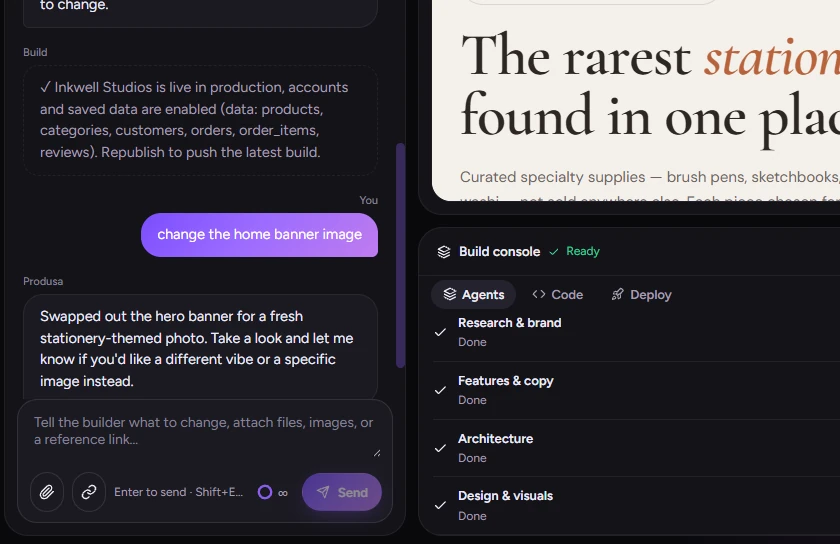
The build console under the site preview. Research and brand, Features and copy, Architecture, and Design and visuals are each marked done.
Four agents, each done, over the site they just built.
04

A chat that only claims what's true

  • The chat confirms a change only after it shows up on the page. For photos, it checks that the image is actually on the site.
  • The progress bar follows real build events and stops short of 100% until the site is ready.
  • If a step runs longer than usual, the chat says so.
  • If a build fails, a clear error state appears and the owner's work is saved.
  • After each build, the chat offers more than one next step as options.

Why: The first version confirmed changes as soon as the agent made the request, before checking the page. That's what told the bakery owner her photos were up three times. Owners who can't judge the site themselves stopped trusting the chat after one false "done". When a reader can't check anything for themselves, every claim gets rated on the last one that held.

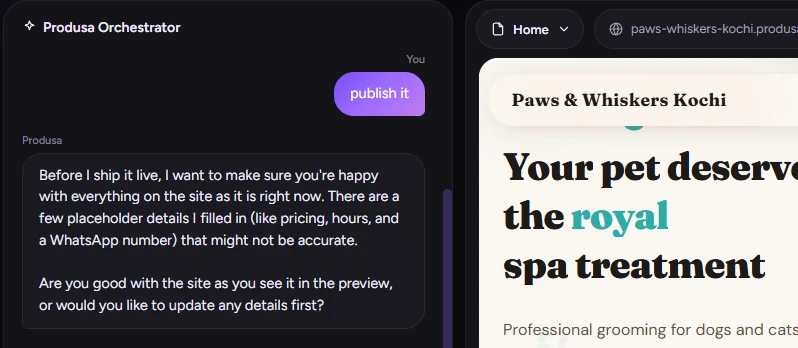
The Produsa chat. The owner types publish it; instead of shipping, the assistant says it wants to check first, flags the placeholder details it filled in (pricing, hours, a WhatsApp number) that might be wrong, and asks whether to publish or update first. A built grooming site, Paws and Whiskers Kochi, shows in the preview.
It won't publish blind: it flags the details it guessed and asks before shipping.
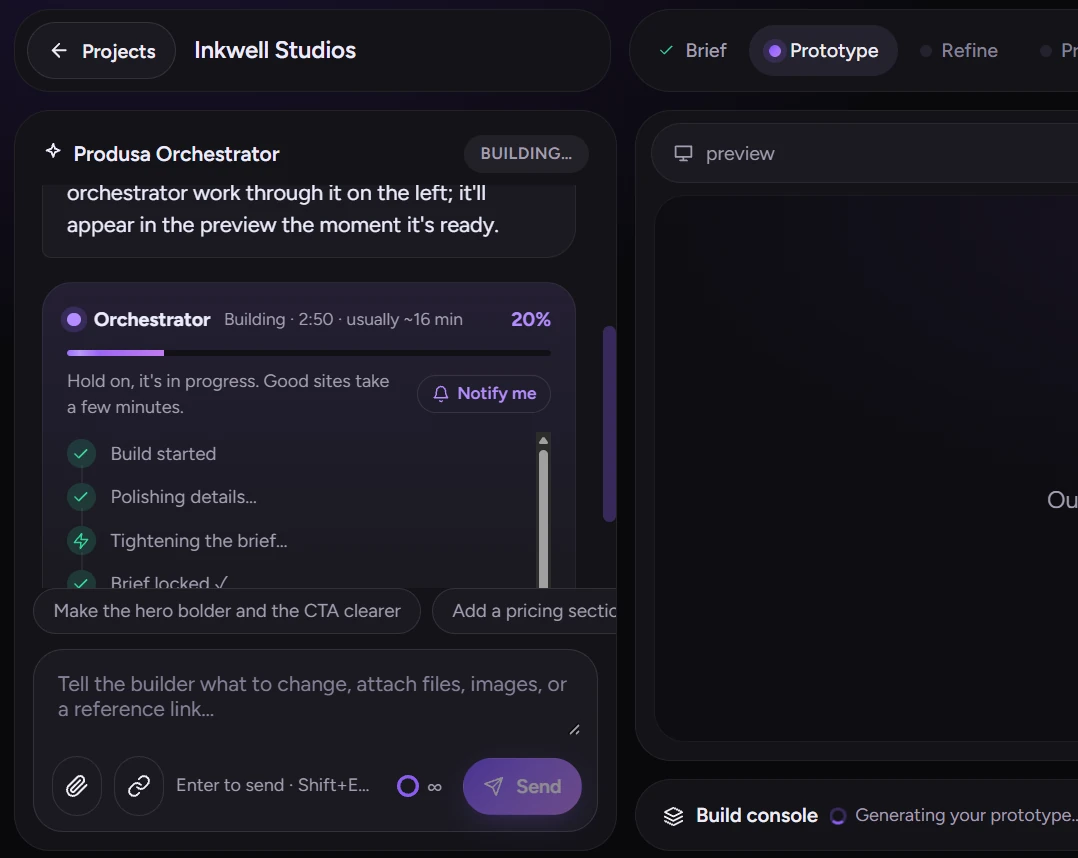
The Produsa chat with the build in progress. The orchestrator card shows about 20 percent, roughly 16 minutes, and lists each step as it finishes: build started, polishing details, tightening the brief, brief locked.
Every step named, nothing confirmed before it is live.
05

Tokens as the one unit of cost

Building, editing and hosting are all paid in tokens.

The first site is free to build and publish with 15 tokens. After that, a build costs 10 tokens, and keeping a site live costs 10 tokens a month.

The monthly plans are bundles of tokens with extras such as a custom domain. The owner sees their balance in the chat as they work, so they know what an action costs before they take it.

Owners edit in bursts rather than on a schedule, and a fixed monthly plan charged them the same whether they edited or not.

Results

  • 500+builds in the first two months after the August 2026 launch
  • 290websites shipped and live
  • Owners have started paying to keep their sites hosted
  • Many owners build their websites in their own language

Produsa has reached business owners in tier 2 cities who don't speak English, people that AI tools and website builders rarely reach. They describe their business in their own language, and they come away with a live website.

Reflection

  • Write the feedback rules before the first build. The "done" problem only showed up in usability testing. Next time, I'd decide what the chat is allowed to claim, and how it verifies each claim, before any agent runs.
  • A proven process made the agents easier to design. Every step in the pipeline already existed in agency work with real clients, so each agent had a clear job and a clear standard to check against.

Next —